
Tested and certified for reliable, easy-to-use, in-home water filtration, the Delta® Clarifi™ Tankless Reverse Osmosis System is certified to filter out more than 90 contaminants from your drinking water. Using high pressure, the Clarifi RO System pushes water through 6 filtration stages:

Stage 1: Clarifi™ Pre-Filter minimizes system clogging and enhances efficiency.
Stages 2-5: Clarifi™ Multi-Stage Composite Reverse Osmosis System uses the following filters.
- Polypropylene filters out large, insoluble particles such as dirt, rust, sand, etc.
- Activated carbon filter reduces chlorine taste and odor and protects the RO filter to improve filter life
- RO membrane reduces very small soluble and insoluble substances, including lead, mercury, radium, copper, arsenic, polyfluoroalkyl substances (PFAS), total dissolved solids (TDS), hardness, parasites (cysts), microplastics, and asbestos
- Carbon block filters residual organic compounds
Stage 6: Clarifi™ Carbon Filter helps reduce residual volatile organic compounds (VOCs), microplastics, pesticides, and pharmaceuticals while removing chlorine taste and odor.
3rd Party Tested and Certified
The Delta® Clarifi™ Tankless Reverse Osmosis System is rigorously tested and certified by IAPMO R&T lab to meet four National Sanitation Foundation (NSF) certifications for reduction of various types of contaminants and one NSF certification for low-lead content in the system, including:
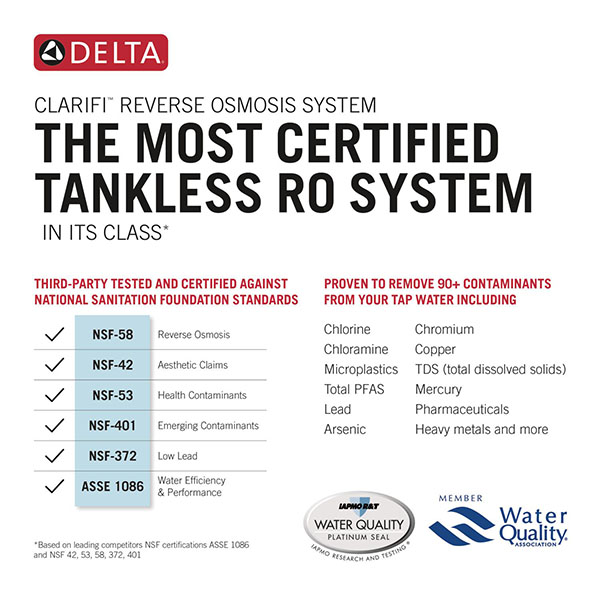
- NSF-42: Non-health related contaminants, including aesthetic impurities that impact taste and/or odor (e.g., chlorine)
- NSF-53: Contaminants that may impact health, including volatile organic compounds (VOCs) and PFAS (commonly known as "forever chemicals")
- NSF-58: Contaminants that are reduced through reverse osmosis, including TDS such as calcium and magnesium, and other optional contaminants (e.g., various chemicals and cysts)
- NSF-401: Emerging contaminants that aren't yet regulated by the EPA (e.g., BPA, DEET and ibuprofen)
- NSF-372: Lead content in plumbing products and components used for drinking water
Water Filtration Certifications
Filtration products can be certified to reduce one or more contaminants for each NSF standard. For example, the Delta® Clarifi™ Tankless Reverse Osmosis System is certified to filter out 57 contaminants under NSF-53, and more than 90 contaminants overall (93 actually!). Certified products included the list of contaminants filtered on a data sheet. That's why it's important to check the data sheets when you're shopping for filtration products. It's a great way to compare models, determine which options are most effective, and confirm that the product reduces contaminants that you are concerned about.
See below to review the full list of harmful contaminants reduced by the Clarifi RO system and which NSF standard(s) the system is certified under for each contaminant.
Disinfectants: Commonly chlorine or chloramine, these additives are used during water treatment to kill bacteria and viruses.
- chloramine (NSF-42)
- chlorine (NSF-42)
Disinfection Byproducts: These chemicals form unintentionally when disinfectants react with organic or inorganic matter in water.
- tribromoacetic acid (NSF-53)
Trihalomethanes:
- bromoform (NSF-53)
- bromodichloromethane (NSF-53)
- chlorodibromomethane (NSF-53)
Inorganic Chemicals: Generally defined as substances that do not contain carbon, these chemicals contaminate water through natural sources or human activities like industrial waste, agricultural runoff, and untreated sewage.
- arsenic (pentavalent) (NSF-58)
- asbestos (NSF-58)
- barium (NSF-58)
- cadmium (NSF-58)
- chromium (hexavalent) (NSF-58)
- chromium (trivalent) (NSF-58)
- copper (NSF-58)
- fluoride (NSF-58)
- lead (NSF-58)
- mercury (NSF-58)
- nitrate (NSF-58)
- nitrate plus nitrite (NSF-58)
- nitrite (NSF-58)
- selenium (NSF-58)
Microorganisms (Cysts): Microscopic organisms can enter water sources through poorly built and maintained wells, fecal matter, and pipe breakage.
- cyst (NSF-58)
- turbidity (NSF-58): Although turbidity is a measure of water clarity, it often indicates microorganisms in the water.
Organic Chemicals: These carbon-based substances enter our water sources through improper waste disposal, accidental spills, and agricultural runoff. Volatile organic compounds (VOCs) are part of this contaminant category.
- alachlor (NSF-53)
- atrazine (NSF-53)
- benzene (NSF-53)
- Bisphenol A (BPA) (NSF-401)
- carbofuran (NSF-53)
- carbon tetrachloride (NSF-53)
- chlorobenzene (NSF-53)
- chloroform (NSF-53)
- 2,4-D (NSF-53)
- dibromochloropropane (DBCP) (NSF-53)
- o-dichlorobenzene (NSF-53)
- p-dichlorobenzene (NSF-53)
- 1,2-dichloroethane (NSF-53)
- 1,1-dichloroethylene (NSF-53)
- cis-1,2-dichloroethylene (NSF-53)
- trans-1,2-dichloroethylene (NSF-53)
- 1,2-dichloropropane (NSF-53)
- cis-1,3-dichloropropylene (NSF-53)
- dinoseb (NSF-53)
- endrin (NSF-53)
- ethylbenzene (NSF-53)
- ethylene dibromide (EDB) (NSF-53)
- heptachlor (H-34, Heptox) (NSF-53)
- heptachlor epoxide (NSF-53)
- hexachlorobutadiene (NSF-53)
- hexachlorocyclopentadiene (NSF-53)
- lindane (NSF-53)
- methoxychlor (NSF-53)
- pentachlorophenol (NSF-53)
- simazine (NSF-53)
- styrene (NSF-53)
- TCCP (tris(1-chloro-2-propyl)phosphate) (NSF-401)
- 1,1,2,2-tetrachloroethane (NSF-53)
- tetrachloroethylene (NSF-53)
- toluene (NSF-53)
- 2,4,5-TP (silvex) (NSF-53)
- 1,2,4-trichlorobenzene (NSF-53)
- 1,1,1-trichloroethane (NSF-53)
- 1,1,2-trichloroethane (NSF-53)
- trichloroethylene (NSF-53)
- xylenes (total) (NSF-53)
Haloacetonitriles (HAN):
- bromochloroacetonitrile (NSF-53)
- dibromoacetonitrile (NSF-53)
- dichloroacetonitrile (NSF-53)
- trichloroacetonitrile (NSF-53)
Haloketones (HK):
- 1,1-dichloro-2-propanone (NSF-53)
- 1,1,1-trichloro-2-propanone (NSF-53)
Pesticides:
- chloropicrin (NSF-53)
- DEET (diethyltoluamide) (NSF-401)
Pharmaceuticals:
- atenolol (NSF-401)
- carbamazepine (NSF-401)
- estrone (NSF-401)
- ibuprofen (NSF-401)
- linuron (NSF-401)
- meprobamate (NSF-401)
- metolachlor (NSF-401)
- naproxen (NSF-401)
- nonylphenol (NSF-401)
- phenytoin (NSF-401)
- trimethoprim (NSF-401)
Sediment/Particulate:
- microplastics (NSF-401)
PFAS: Also known as "forever chemicals," these synthetic chemicals don't easily break down in the environment and are used in many consumer, commercial, and industrial products.
Total PFAS (per- and polyfluoroalkyl substances):
- perfluorobutane sulfonate (PFBS) (NSF-53, NSF-58)
- perfluorodecanoic acid (PFDA) (NSF-53, NSF-58)
- perfluoroheptanoic acid (PFHpA) (NSF-53, NSF-58)
- perfluorohexane sulfonic acid (PFHxS) (NSF-53, NSF-58)
- perfluorononanoic acid (PFNA) (NSF-53, NSF-58)
- perfluorooctane sulfonate (PFOS) (NSF-53, NSF-58)
- perfluorooctanoic acid (PFOA) (NSF-53, NSF-58)
Radionuclides: These contaminants can emit radiation. They enter water from natural deposits in the earth's crust or from human activities like mining and oil drilling.
- radium 226/228 (NSF-58)
Secondary/Aesthetic: These substances can affect water's taste, odor, or appearance.
- particulate, Class I particles (NSF-42)
- total dissolved solids (TDS) (NSF-58)
Want more information? Check out "What Is Water Quality?" to learn where drinking water comes from, how the EPA protects it, and how to test your water. You can also use the Delta® Water Quality Tool to check the water in your area.
To better understand water filtration, visit "What Is Water Filtration and How Does It Work." Explore Delta® Clarifi™ filtration products for the kitchen and bath to find out how our products can help you enjoy cleaner water in your home.